Direct answer
Already own Mini 4 Pro? Keep it.
- Mini 4 Pro owners: Upgrade for the larger 1-inch camera, 4K/120fps slow motion, forward LiDAR or 42 GB storage. Otherwise, your current kit still delivers.
- Buying your first Pro Mini?: Choose Mini 5 Pro for the stronger camera package. Choose Mini 4 Pro when a complete kit offers a substantial saving.
For most Mini 4 Pro owners, we see Mini 5 Pro as an incremental upgrade rather than a must-buy replacement.
At a glance
What actually changes
| What matters | DJI Mini 4 Pro | DJI Mini 5 Pro |
|---|---|---|
| Best for | Keep a capable existing kit; buy at a meaningful full-kit saving | A camera and workflow upgrade for a specific recurring need |
| Camera system | Single wide-angle camera; no separate telephoto camera | Single 1-inch camera; no separate telephoto camera |
| Sensors | 1/1.3-inch CMOS | 1-inch CMOS |
| Video modes | 4K/100fps slow motion; 4K/60fps HDR | 4K/120fps slow motion; 4K/60fps HDR |
| Vertical video | True vertical shooting | True vertical shooting |
| Obstacle sensing | Omnidirectional vision sensing; no forward LiDAR | Omnidirectional vision sensing plus forward-facing LiDAR |
| Subject tracking | ActiveTrack 360° | ActiveTrack 360° |
| Internal storage | 2 GB | 42 GB |
| Transmission | DJI O4 | DJI O4+ |
| Claimed maximum flight time, standard battery | 34 min | 36 min |
| Takeoff weight with standard battery | <249 g; standard configuration | Approx. 249 g; configuration matters |
| Controller options in verified packages | Package-dependent: DJI RC-N2 or DJI RC 2 | Package-dependent: DJI RC-N3 or DJI RC 2 |
Standard-battery manufacturer maximums are measured in controlled conditions, not usable filming time. Larger optional batteries change both flight time and weight. Compare the same battery category and controller type.
Biggest difference
Mini 5 Pro buys you a larger camera, forward LiDAR and much more internal storage. Mini 4 Pro already covers true vertical video, tracking and compact travel. This is a camera upgrade, not a whole new kind of drone.
Current buying options
Compare the complete packages
As an eBay Partner, DroneReviewed may earn a commission if you buy through these links.
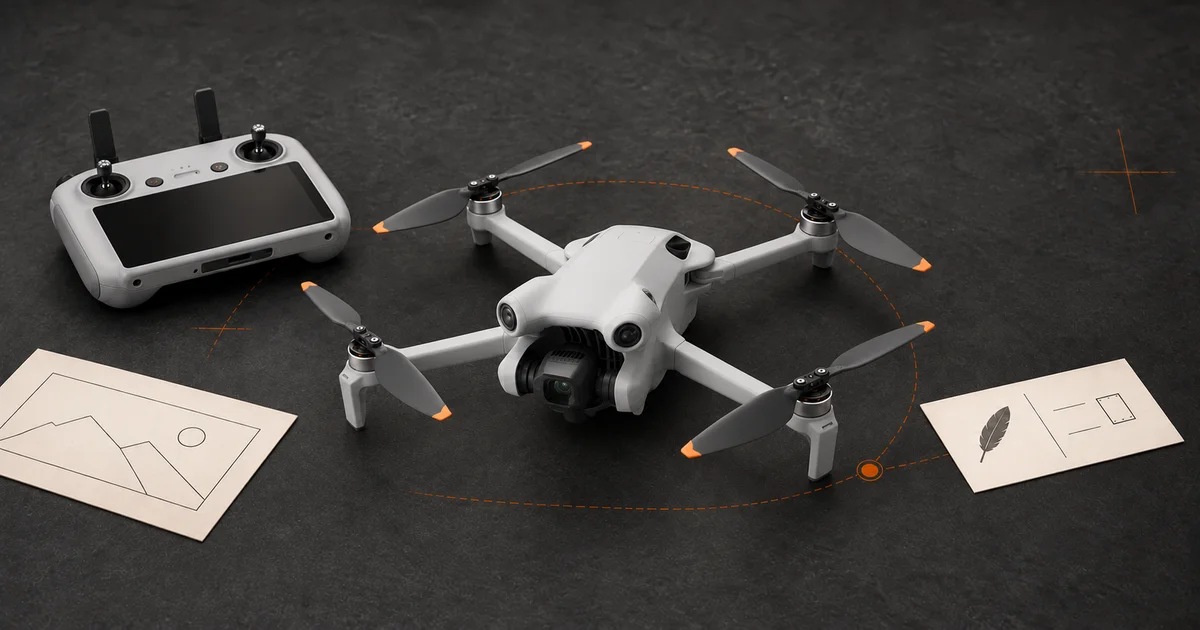
DJI Mini 4 Pro
Great value when the complete kit costs less
Read review →Check current price on eBay →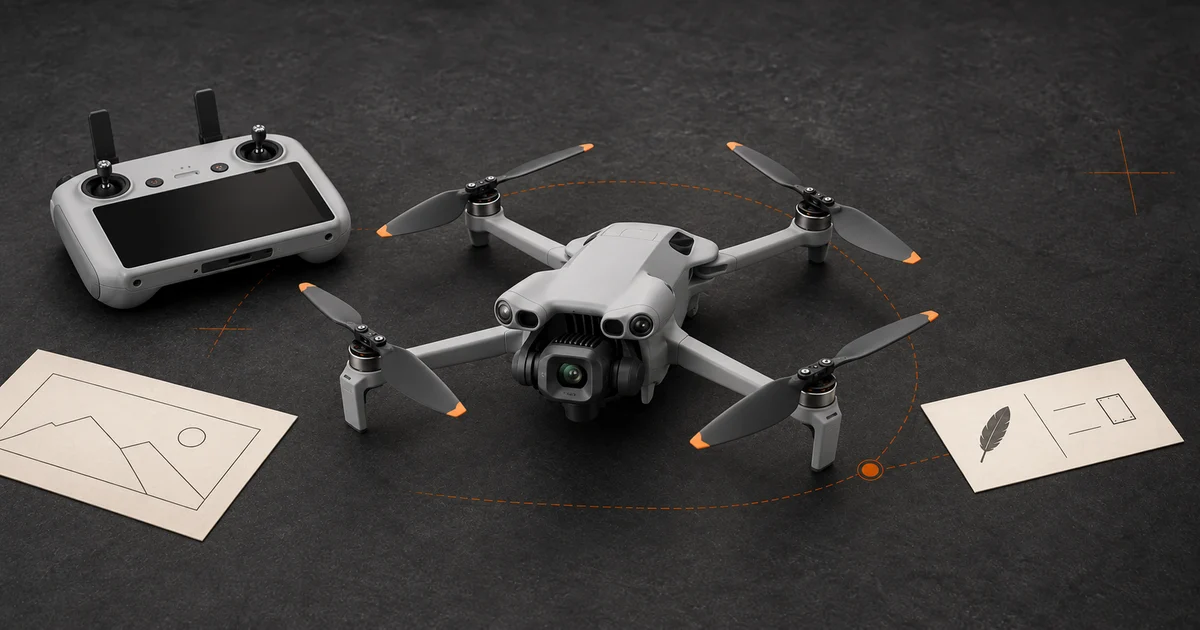
Compare complete kits with the controller and batteries you want. These links open exact-model eBay searches; illustrations show the models, not individual seller listings.
Camera decision
More headroom for video and difficult light
The 1-inch sensor gives Mini 5 Pro more camera headroom, but the improvement will not look dramatic in every scene. Both use a single wide camera; neither gives you a separate telephoto lens.
Pixpro's paired camera samples found a modest still-photo improvement, including less noise and chromatic aberration, and a more noticeable video improvement. Its comparison supports investigating the upgrade for video work, while leaving room for a satisfied Mini 4 Pro photographer to keep the older kit.
TechRadar's Mini 4 Pro review found impressive overall image quality and favored the lower-resolution still mode in low light. A high megapixel count does not remove the need to choose exposure and capture mode carefully.
Mini 5 Pro is the more appealing choice for evening footage, color work and high-frame-rate video. Mini 4 Pro remains a strong value for daylight travel clips and portrait posts. Compare samples at the resolution you deliver to see how much the difference matters to your work.
The working kit
Portrait capture is already here
Both cameras turn for true vertical shooting. Mini 5 Pro adds wider gimbal roll movement for more creative angles, while Mini 4 Pro already makes portrait capture straightforward.
Mini 5 Pro's extra internal storage is useful travel insurance when a card is missing or full. Keep removable storage and a backup routine in the kit, but the larger built-in capacity makes an extra sequence easier to save.
Mini 5 Pro adds forward-facing LiDAR to vision sensing. In Pixpro's tests, frontal detection continued in dim conditions where Mini 4 Pro's vision sensing stopped working. That is a practical benefit for low-light flight assistance. Thin wires, branches and reflective surfaces still demand care.
Practice tracking in open space, keep the aircraft in sight and check the return route. Our Return to Home guide covers the setup that makes flight assistance useful.
For existing owners
Should you replace your Mini 4 Pro?
Keep Mini 4 Pro if…
- Your finished footage already meets the job.
- Daylight travel and portrait clips dominate your flights.
- Your batteries, gimbal and aircraft remain serviceable.
- The upgrade would leave less budget for trips, batteries or practice.
Upgrade to Mini 5 Pro if…
- Camera limitations repeatedly affect work you deliver.
- Its recording modes or gimbal movement solve a specific shot need.
- Internal storage is a recurring practical constraint.
- You accept the replacement-kit cost and have verified seller support.
Write down three shots your current drone cannot deliver satisfactorily. Then check whether the newer camera solves those limitations. If the problem is exposure, composition or flight technique, a new drone may not fix it.
Calculate the upgrade after a realistic sale value for your existing kit, fees and replacement charging equipment. Do not assume Mini 4 Pro batteries or hubs carry over. Although verified packages for both include an RC 2 option, confirm the exact controller and firmware pairing before budgeting to reuse it.
For a first purchase
The full-kit saving must survive checkout
Buy a healthy Mini 4 Pro kit when the saving leaves room for extra batteries or your next trip. If equivalent kits cost nearly the same and support is comparable, choose Mini 5 Pro: its camera and storage additions are worth having from the start.
Official US availability varies. Check stock and regional support before comparing prices, then use the complete-kit links above to see current seller options.
- Match the kit: compare controller type, usable batteries, charger, storage, condition and shipping. Avoid comparing a complete kit with an aircraft-only listing.
- For used stock: check gimbal operation, battery condition, account unbinding, included parts and written returns. Budget for worn batteries before calling it a saving.
- Confirm support: ask who handles repairs and where the aircraft goes. DJI's after-sales policy ties warranty service to the purchase service region.
- Check flying weight: battery and accessories affect the configuration. FAA recreational guidance uses a 250 g registration threshold; the operating category also matters. See our US registration guide before assuming an exemption.
Compare the whole bag, including the controller, spare batteries and charging equipment. For trips, use the mini-drone guide and check your airline's current battery rules.
Common questions
Before choosing a Mini
Is Mini 5 Pro worth upgrading from Mini 4 Pro?
When its camera or workflow solves a recurring problem and the replacement-kit cost is acceptable. Keep Mini 4 Pro if your current output already meets your needs.
Does Mini 4 Pro shoot true vertical video?
Yes. Both offer true vertical shooting. Mini 5 Pro adds broader gimbal roll movement, rather than introducing portrait capture to this pair.
Is the Mini 5 Pro camera much better than Mini 4 Pro?
Expect more camera headroom, especially for video and difficult light, rather than a dramatic change in every shot. Pixpro's paired samples showed a more noticeable video improvement than still-photo improvement. For daylight photos and phone-size posts, Mini 4 Pro can still be enough.
Can I reuse Mini 4 Pro batteries and accessories?
Do not assume batteries or charging hubs interchange. Verify each exact accessory and the controller's current compatibility and firmware before calculating the upgrade cost.
Which is better for travel?
Either can suit a compact travel setup. A working Mini 4 Pro already in your bag may be the best value; Mini 5 Pro earns its place when the camera upgrade matters to the trip. Compare the full kit, not a rounded aircraft weight.
Does either avoid FAA registration?
Check actual ready-to-fly weight and operating category. Larger batteries and accessories can change the result, and the recreational exception is not the Part 107 rule.
Sources and methodology
Evidence behind the decision
Researched by DroneReviewed Editorial; sources checked October 2, 2026. Recommendations are our editorial judgment, informed by DJI documentation and the independent tests linked below. DroneReviewed has not flown these aircraft.
- DJI Mini 4 Pro specifications (DJI; checked 2026-10-02)
- DJI Mini 4 Pro FAQ (DJI; checked 2026-10-02)
- DJI Mini 4 Pro US Store (DJI; checked 2026-10-02)
- DJI Mini 4 Pro review (TechRadar; checked 2026-10-02)
- DJI Mini 4 Pro vs Mini 5 Pro sample comparison (Pixpro; checked 2026-10-02)
- DJI Mini 5 Pro product page (UK) (DJI; checked 2026-10-02)
- DJI Mini 5 Pro user manual (DJI; checked 2026-10-02)
- DJI Mini 5 Pro review: A new gold standard for mini drones (Tom's Guide; checked 2026-10-02)
- DJI after-sales policy (checked October 2, 2026)
- FAA recreational guidance (checked October 2, 2026)
- DroneReviewed editorial methodology
The Mini 4 Pro weight is DJI's published bound; Mini 5 Pro's approximate display is rounded from the shared 249.9 g record. Flight-time figures use standard batteries. Dates describe the source check, while the buying links lead to current seller options.