Direct answer
Pay for the camera only when you will use it.
Choose the Mini 4K for a first camera drone, open-space practice and daylight footage. Choose the Mini 5 Pro when true vertical video, moving-subject tracking or a larger camera are part of your actual shooting plans. Those features can justify the higher total kit cost if you will use them. Skip the Mini 4K if you need forward obstacle sensing; skip the Mini 5 Pro if this season is mainly practice or the seller, warranty and exact US package are unclear.
At a glance
The differences that change the purchase
| What matters | DJI Mini 4K | DJI Mini 5 Pro |
|---|---|---|
| Best for | Learning, daylight and a tighter budget | Planned video, portrait framing and tracking |
| Camera sensor | 1/2.3-inch CMOS | 1-inch CMOS |
| Maximum photo resolution | 12 MP | 50 MP |
| Video modes | 4K/30fps | 4K/120fps slow motion; 4K/60fps HDR |
| Obstacle sensing | Downward positioning; no forward obstacle avoidance | Omnidirectional vision sensing plus forward-facing LiDAR |
| Subject tracking | QuickShots, not continuous subject tracking | ActiveTrack 360° |
| Vertical video | Landscape capture; crop for portrait output | True vertical shooting |
| Internal storage | None; use a microSD card | 42 GB |
| Transmission | DJI O2 | DJI O4+ |
| Claimed maximum flight time | 31 min | 36 min |
| Standard takeoff weight | 246 g | 249.9 g |
| Controller in package | DJI RC-N1C | Package-dependent: DJI RC-N3 or DJI RC 2 |
Flight times are controlled-condition manufacturer maximums, not usable flight plans. Weight depends on the actual battery and accessories. Controller choice depends on the package.
Current buying options
Check the two complete kits
As an eBay Partner, DroneReviewed may earn a commission if you buy through these links.
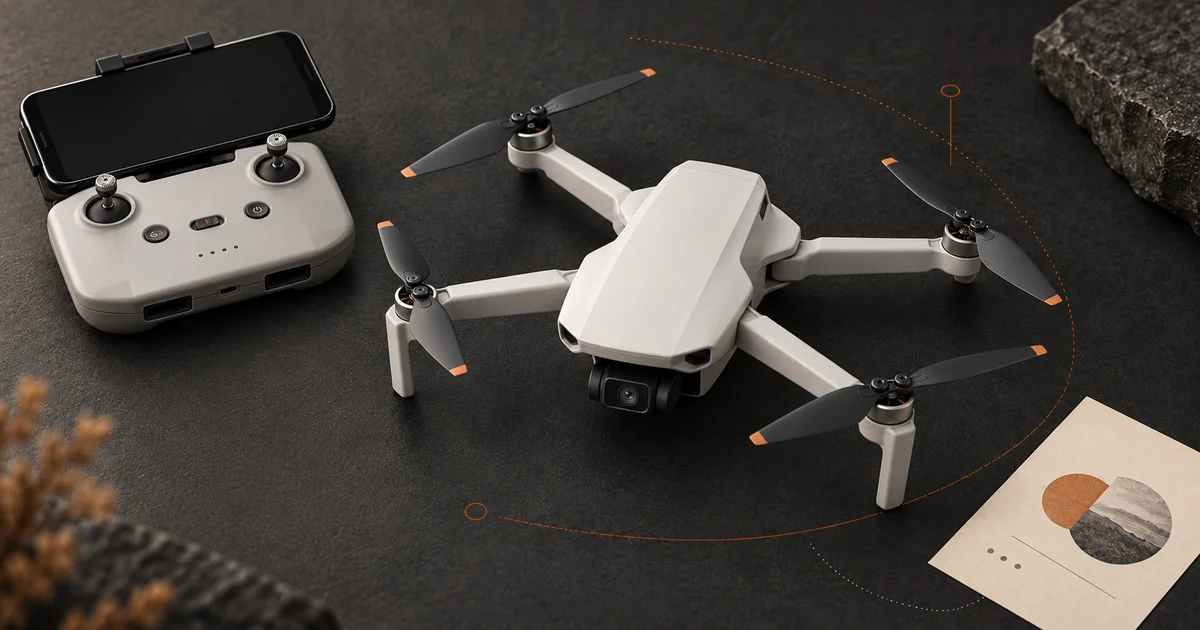
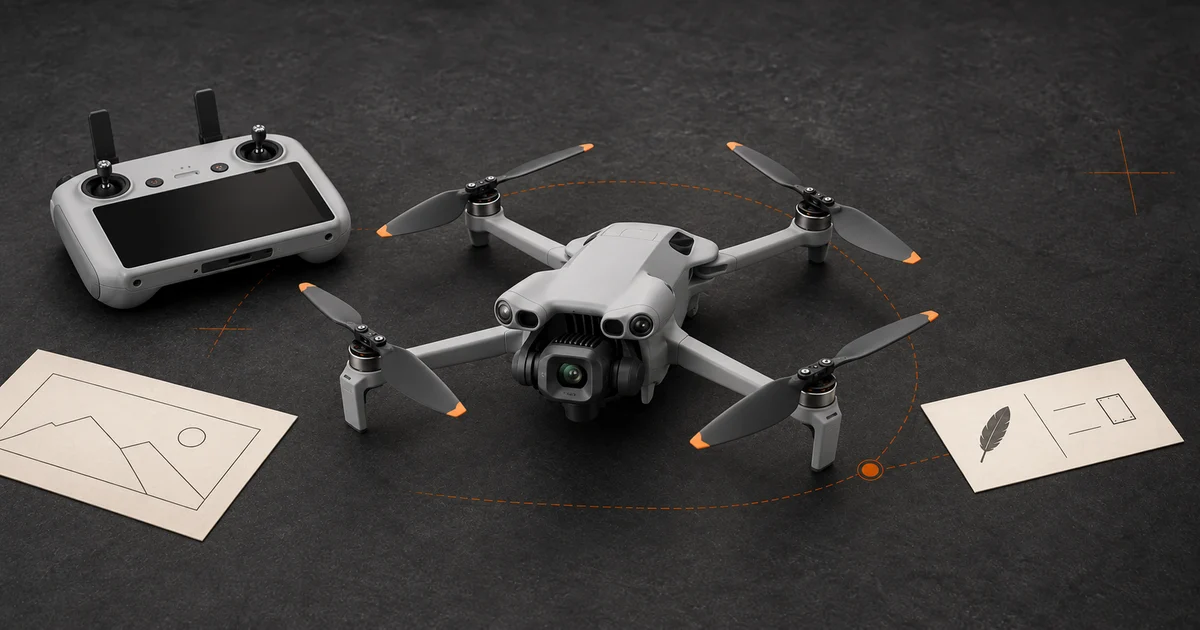
DJI Mini 5 Pro
For portrait video, tracking and camera work
Read review →Check current price on eBay →Illustrations show the models, not seller listings. Links open exact-model eBay searches; check the controller, battery, condition, regional version, returns and support in each listing. Prices and availability can change.
Camera decision
Where the camera upgrade matters
Both drones can record stabilized 4K video. The useful question is how often you will shoot beyond an easy, bright landscape. The Mini 4K's smaller sensor is a sensible starting point for daylight trips and steady wide shots. The Mini 5 Pro's larger sensor and faster video options give you more tools for deliberate footage, especially when the lighting or movement is harder to manage.
Daylight and first flights
Choose the Mini 4K when you mainly want weekend landscapes and family-trip clips. Learn smooth turns, exposure and framing before deciding that the camera is the limitation. The cheaper aircraft still has a mechanical gimbal and RAW photo capture.
Evenings, movement and portrait video
The Mini 5 Pro is the stronger candidate for sunset scenes, action and a portrait-first workflow. Its HDR and slow-motion modes offer different capture options; they do not guarantee an attractive image without careful exposure and a useful subject.
Photo resolution also differs: 12 MP on the Mini 4K versus a published maximum of 50 MP on the Mini 5 Pro. More pixels are not a promise of four times better photographs. Light, motion, lens performance and processing still shape the result.
Vertical framing is a clearer practical difference. The Mini 5 Pro rotates its camera for true vertical shooting; the Mini 4K requires cropping landscape footage for portrait output. That crop reduces the composition you retain. Its rotating gimbal also supports more flexible camera movement. If the shot is your main decision, start with our camera-drone buying guide.
Safety and tracking
Which gives a beginner more help?
The Mini 4K uses downward positioning but has no forward obstacle avoidance. You must choose a clear practice area and judge the route yourself. QuickShots provide preset camera moves; they are not the same job as continuously following a moving subject.
The Mini 5 Pro adds multidirectional vision sensing, forward-facing LiDAR and ActiveTrack 360°. Those are meaningful reasons to consider it for self-filming or moving subjects. DJI describes sensing capability; we do not treat that description as a measured crash-prevention result.
Neither aircraft makes wires, branches or a poorly planned route safe. Sensing depends on the environment, and tracking still needs an attentive pilot. Keep the sensors clean, read the model's operating limits and practice in open space first. Our beginner guide helps separate learning to fly from paying for automated footage.
Flight and storage
A longer claim, a newer link
DJI claims 31 minutes for the Mini 4K and 36 minutes for the Mini 5 Pro with their standard batteries. That difference is useful context, not extra time you can spend before returning. Wind, battery condition and the return route change the time available.
The Mini 4K uses O2 transmission; the Mini 5 Pro uses O4+. Compare the supported system and controller, rather than planning flights around headline distance figures. A radio's published reach does not establish a safe route or permission to fly that far.
The Mini 5 Pro's 42 GB of internal storage provides a fallback when a card is missing. The Mini 4K has no internal storage for original footage, so a suitable microSD card belongs in the kit budget. Neither difference makes checking storage before takeoff unnecessary.
Choose by scenario
Which fits the footage you want?
Choose Mini 4K if…
- This is your first camera drone and practice is the priority.
- Most footage will be daylight landscapes or ordinary family trips.
- You can fly manually in an open area and do not need subject following.
- Saving on the aircraft leaves room for the complete kit.
Choose Mini 5 Pro if…
- You already plan to film moving subjects or yourself.
- Portrait video is a recurring deliverable.
- Evening scenes and more deliberate video justify the camera upgrade.
- You value the screen-controller option and have checked the exact package.
For travel, both are compact aircraft; the controller, batteries and charging gear determine what you carry. A cheaper drone you pack regularly can be more useful than a better camera you leave at home. Compare the complete mini-drone carry kit before choosing by aircraft size alone.
Budget or premium
What the extra money buys
The Mini 5 Pro bundles a larger camera, more video options, true vertical capture, subject tracking, broader sensing, internal storage and a screen-controller package option. Treat that as a group of jobs you can use. Buying every available feature is not the same as improving every daylight clip.
It does not buy permission to ignore obstacles, a guarantee that every battery setup stays below 250 g, or a fixed improvement proportional to the price. It also cannot replace practice with framing and exposure.
Compare actual complete-kit totals. If the Mini 5 Pro package costs twice as much as the Mini 4K package you are considering, ask which recurring shots justify that difference. This is a decision example, not a current price ratio. If $500 is your ceiling, use the under-$500 guide to budget for the controller, batteries and storage.
Before checkout
Compare the complete kit
- Controller: Mini 4K packages use the RC-N1C phone controller. Mini 5 Pro packages can use an RC-N3 phone controller or an RC 2 screen controller. Compare the seller's exact contents.
- Battery: Decide how many sessions you need and which batteries are included. A larger battery or accessories can change the flying weight.
- US purchase path: Check the regional version, seller, returns, warranty and support for the exact listing. A third-party listing or UK product page does not establish official US availability.
Common questions
Before you choose
Is Mini 5 Pro worth upgrading to from Mini 4K?
When portrait capture, tracking, evening footage or additional video modes solve a recurring limitation, the upgrade is easier to justify. If daylight landscapes are still your main use, improve flight technique and compare complete-kit costs first.
Does Mini 4K have obstacle avoidance?
It has downward positioning, but no forward obstacle avoidance. Choose a clear route and an open practice area.
Can both shoot vertical video?
The Mini 5 Pro supports true vertical capture. Mini 4K footage can be cropped into portrait format, with less of the original frame retained.
Which is the better first drone?
Mini 4K is the simpler budget choice for open-space practice. Mini 5 Pro is worth considering when the first-drone plan already includes tracking or more demanding camera work. Sensing does not remove the need to learn the controls.
Is Mini 5 Pro always below 250 g?
No blanket assumption is appropriate. Its published standard configuration sits close to the threshold. Check the actual aircraft, battery and accessories; a different setup can weigh more.
Does an eBay listing establish US support?
No. Confirm regional compatibility, seller terms and the support path for that exact kit before buying. Availability and warranty are separate questions from camera specifications.
Sources and methodology
Where the facts came from
Research and comparison by DroneReviewed Editorial. Product specifications come from DJI; recommendations are our interpretation of those specifications and the source-led reviews. DroneReviewed does not claim original flights, camera samples or measurements.
- DJI Mini 4K specifications
- DJI Mini 5 Pro features and packages (UK)
- DJI Mini 5 Pro user manual
- Our editorial methodology
The comparison facts were checked October 1, 2026. Manufacturer flight-time and sensing claims are not independent tests. Recheck the configuration, support and seller before purchase.