Direct answer
Pick the shot before the sensor.
Choose the DJI Flip for easy self-filming and strong everyday video at a lower entry price. The DJI Mini 5 Pro is the compact step up when you want a larger sensor, true vertical framing, and more flight assistance. The DJI Air 3S earns its extra size when you regularly need both a wide view and a 70 mm equivalent telephoto view. For occasional daylight landscapes, the less costly DJI Mini 4K may already be enough.
Your photo album is a better starting point than a spec sheet
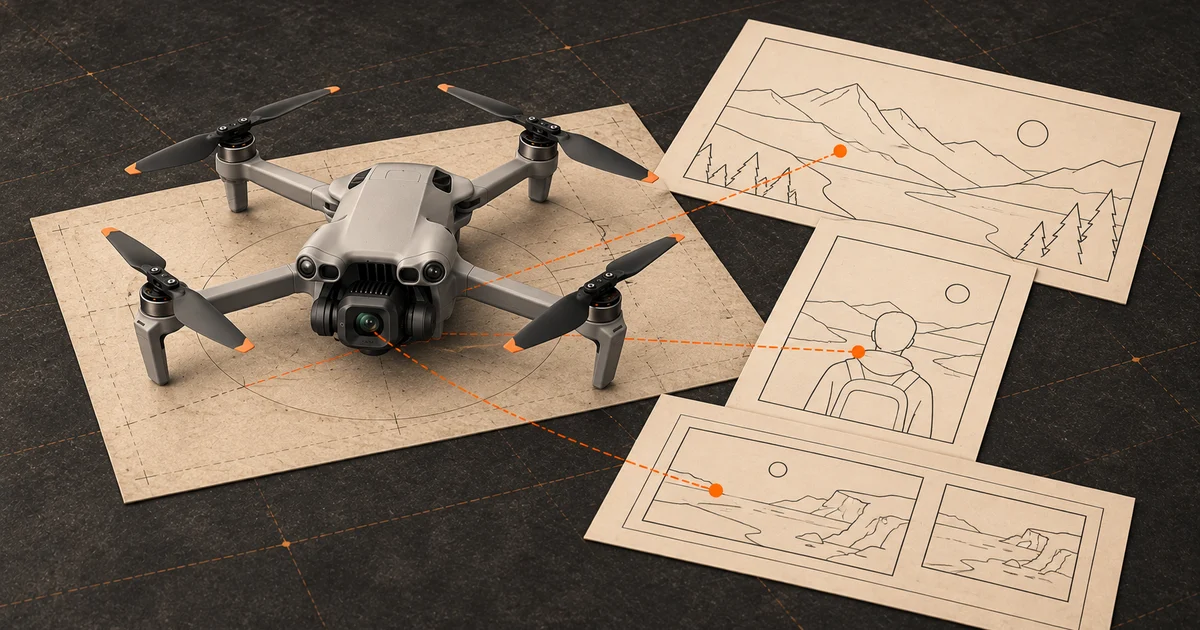
Look at the pictures you already take. A person walking along a trail needs a different aircraft from a photographer who wants a clean landscape frame at dusk. A distant lighthouse needs a different lens from a group standing below the drone. Bigger numbers do not solve every framing problem.
| The shot | Start with | Why | The compromise |
|---|---|---|---|
| A short clip of yourself on a walk | DJI Flip | Quick subject tracking and guarded propellers | Limited sensing; leave plenty of space |
| Travel scenery, portraits, and vertical posts | DJI Mini 5 Pro | Larger 1-inch camera and rotating gimbal | Premium cost and US availability questions |
| A wide landscape, then a tighter view of a distant feature | DJI Air 3S | Separate 24 mm and 70 mm equivalent cameras | Larger aircraft, higher cost, registration for recreational use |
Those are starting points, not a quality ranking. Consider what must fit in your bag and how much time you will spend setting up each shot.
When the Mini 4K is enough
If you mainly want a steady, wide view of a beach or hiking trail in daylight, the DJI Mini 4K’s three-axis gimbal and 4K/30 video can do that job without paying for a larger sensor or a second lens. It gives up automated subject tracking and the Air 3S’s tighter optical view. Start with the beginner drone comparison if you are also learning to fly; spend on a camera upgrade when you can name the shot your current kit cannot make.
Scene one: you are in the frame
For a solo walk or a family picnic, the DJI Flip is the least fussy choice here. Its subject-tracking modes help make a usable clip while you are away from the controller. The 1/1.3-inch sensor and stabilized 4K recording give it more room for ordinary camera work than a tiny selfie drone such as the Neo. Then you can take the controller and compose a standard overhead shot.
The catch is the environment. Full propeller guards and automatic braking do not see every wire or branch. Try this: frame your first tracking shot in a broad, empty clearing. Walk the route yourself and keep the aircraft’s path away from people. If most of your video is handheld-style close-ups rather than aerial context, a drone may add effort without improving the story.
Scene two: one small bag, several kinds of image
The DJI Mini 5 Pro is the compact camera specialist. Its 1-inch sensor gives you a stronger starting point for difficult light and color work, while the gimbal turns for a real portrait frame rather than cropping a landscape recording. For someone who posts both a horizontal travel film and vertical clips, that is a useful difference.
It is still an expensive way to take occasional noon-day panoramas. The published 249.9 g weight is close enough to the US registration threshold that you should verify the actual flight configuration, particularly batteries and accessories, rather than assuming the word “Mini” settles the rule. Try this: list the shots you would make vertically in camera. If you can only name one, save the money and start with a simpler model. Confirm current US retail and support before treating this as a purchase recommendation.
Read the Mini 5 Pro review for the weight, controller, and buying decision behind that camera upgrade.
Scene three: the subject is farther away
The DJI Air 3S pairs a 24 mm equivalent wide camera with a 70 mm equivalent medium telephoto camera. At a coast or mountain overlook, the wide view can show the whole setting, while the second camera can isolate a distant feature without immediately flying nearer to it. Its larger body also means a more substantial kit to carry and a recreational registration requirement in the US.
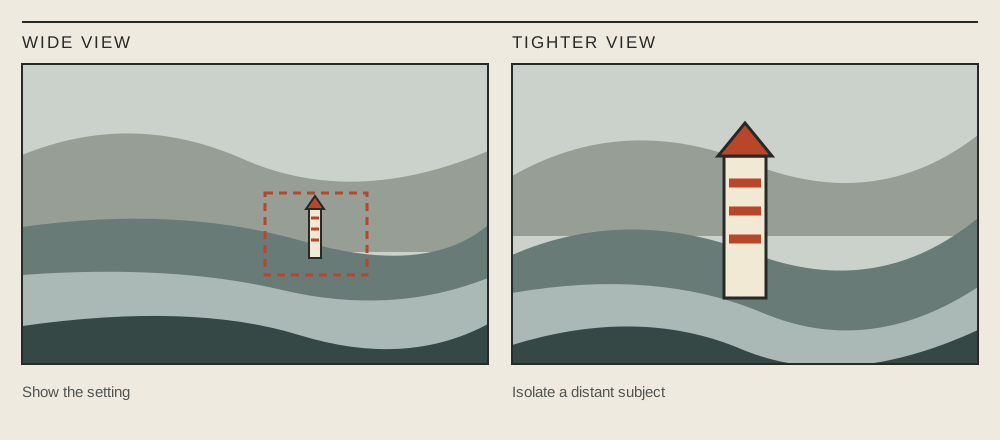
The second camera is the reason to choose it, not a reason for everyone to pay more. Try this: review ten images you wish you had taken from the air. If most need a tighter composition from a safe distance, the Air 3S has a clear job. If nearly all are wide establishing shots, a smaller camera drone is easier to justify. The independent Air 3S review includes real sample images to examine before you buy. Neither lens is permission to fly over a restricted area or beyond visual line of sight.
Our Air 3S review looks at the dual-camera tradeoff, the misleading 9x zoom headline, and the size of the full kit.
If these are your final two candidates, use the Mini 5 Pro vs Air 3S comparison to decide whether true vertical capture or a separate telephoto camera matters more for your recurring shots.
What the camera numbers do not tell you
- Megapixels are not the finished photo. Lens, processing, light, exposure, and whether you can save an editable file all matter. A 48 or 50 MP headline does not guarantee a better-looking social post.
- “4K” does not describe the movement. Stabilization, frame rate, and the ease of repeating a shot can affect your footage more than resolution. Plan a slow, simple move before chasing 4K/100 or 4K/120 modes.
- Sensing is assistance, not insurance. Small wires, thin branches, and changing light remain problems. Give your shot an open exit path and be ready to stop it.
If your needs sit between these choices, compare the exact sample output, controls, and available US kit before choosing. If bag space matters as much as image quality, see the mini-drone portability comparison. If the footage you want is an immersive first-person pass instead of a composed aerial frame, read the Avata 2 review. The best upgrade is one that solves a shot you have actually missed.
Sources
Sources behind the shortlist
Manufacturer camera modes and flight times are capability claims. The practical comparisons here are editorial judgments supported by the cited reviews; they are not original sample-image tests.
- DJI Mini 4K specifications, DJI. Manufacturer source. Checked . Shared Mini 4K and Mini 2 SE page; used for Mini 4K camera and gimbal capability.https://www.dji.com/mini-2-se/specs
- DJI Flip specifications, DJI. Manufacturer source. Checked .https://www.dji.com/flip/specs
- DJI Flip review, TechRadar. Independent source. Checked .https://www.techradar.com/cameras/drones/dji-flip-review-a-new-breed-of-beginner-drone
- DJI Mini 5 Pro user manual, DJI. Manufacturer source. Checked . Used for the official 249.9 g nominal configuration and battery caveats.https://dl.djicdn.com/downloads/DJI_Mini_5_Pro/UM/20251210/DJI_Mini_5_Pro_User_Manual_en.pdf
- DJI Mini 5 Pro product page, DJI. Manufacturer source. Checked . Used for 1-inch sensor and true vertical shooting; this regional store page does not establish US availability.https://store.dji.com/sg/product/dji-mini-5-pro
- DJI Mini 5 Pro review, TechRadar. Independent source. Checked .https://www.techradar.com/cameras/drones/dji-mini-5-pro-review
- DJI Air 3S specifications, DJI. Manufacturer source. Checked .https://www.dji.com/air-3s/specs
- DJI Air 3S store configuration, DJI. Manufacturer source. Checked . Used to check current US configuration and availability, which may change.https://store.dji.com/product/dji-air-3s
- DJI Air 3S review, TechRadar. Independent source. Checked .https://www.techradar.com/cameras/drones/dji-air-3s-review
- Recreational flyers and model aircraft, FAA. Government source. Checked . Used for the US recreational registration and visual-line-of-sight distinctions.https://www.faa.gov/uas/recreational_flyers
Editorial disclosure: Camera and flight claims come from manufacturer documentation and independent reviews, not DroneReviewed flight tests. US stock, configurations, firmware, and prices need a fresh check before purchase.