Start here
Is the Mini 4K a good first drone?
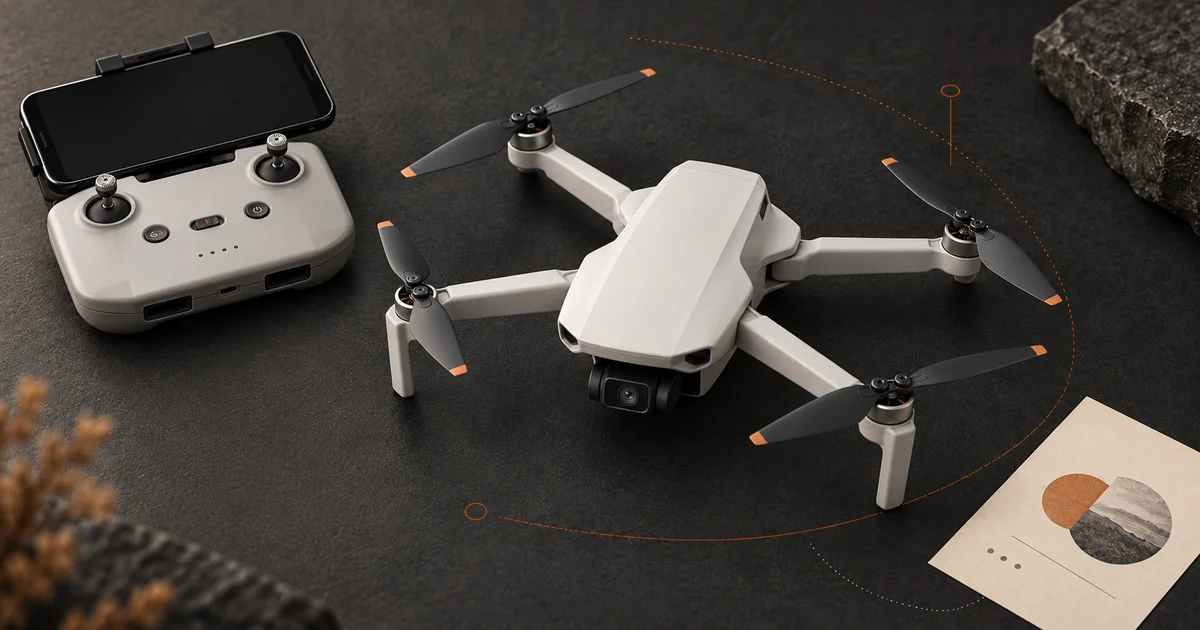
Your first drone does not need to follow you through a forest, shoot a professional film, or cost a small fortune. It needs to be easy to understand, reliable enough to learn with, and capable of recording footage you will actually keep. That is exactly where the DJI Mini 4K fits. It gives a beginner the controls and stable camera of a proper GPS drone without charging for advanced automation, but the lower price also means no obstacle avoidance, no continuous subject tracking, and little room for low-light mistakes.
Current eBay listings
DJI Mini 4K
As an eBay Partner, DroneReviewed may earn a commission if you buy through these links.
Prices and availability can change.
The useful version
What makes it beginner-friendly
What makes the first week easier
- GPS-assisted hovering, Return to Home, a real controller, and a three-axis gimbal create a proper camera-drone experience rather than a toy-drone compromise.
- Daylight 4K video is stable and detailed enough for travel, family clips, and learning basic aerial composition.
- The 246 g standard configuration is easy to carry and leaves more room for a beginner to spend on batteries, a card, and practice.
What can catch a beginner out
- There is no forward, rear, or side obstacle avoidance. The downward sensors help it hold position; they do not watch the route.
- The small 1/2.3-inch camera loses flexibility in high-contrast scenes and low light, and there is no 10-bit color profile for heavy editing.
- QuickShots are useful presets, but the Mini 4K cannot track a moving subject continuously and cannot rotate the camera for true vertical video.
Why this is a real drone, not an expensive toy
The important Mini 4K features are not the dramatic ones in the advertising. GPS-assisted hovering helps the aircraft stay where it is told. Return to Home provides a recovery plan when configured correctly. The physical controller gives the pilot the same two-stick language used by more advanced camera drones. The three-axis gimbal keeps the horizon and framing calm while the aircraft moves underneath it.
Those basics are why the Mini 4K makes sense as a first drone. Cheap toy models may promise 4K on the box but often combine weak positioning, unstable video, short practical range, and vague support. The Mini 4K is limited, but its limitations are clear and its core behavior is predictable.
That does not make it crash-proof. Its sensing system looks downward to help with positioning and landing. It does not see the branch, fence, or wall ahead. A wide open practice area is part of the product decision, not an optional safety tip.
Your first flight: what to expect
The first useful session should feel deliberately uneventful. The Mini 4K needs a compatible phone, the DJI Fly app, charged batteries, a clear launch area, and enough time for setup before anything leaves the ground. Once GPS positioning is ready, a beginner can lift into a low hover, make small control inputs, and learn how the aircraft responds while the gimbal keeps the picture calmer than the drone itself may feel.
Update, connect, check the propellers, confirm the Return to Home height, and wait for a reliable position lock.
Practice hovering, gentle turns, and returning to the same spot in a wide open area before trying camera moves.
Come back before the battery warning becomes the plan. The advertised final minutes are not practice time.
The main surprise is usually not difficulty but sensitivity. Small stick movements are enough. The absence of forward obstacle sensing matters most when confidence grows faster than judgment, so the best first-flight feature is still an empty field.
If the complete package must stay below a firm ceiling, use the under-$500 kit comparison to count batteries, storage, and the controller rather than the aircraft alone.
The camera is good enough, and that is the point
The 1/2.3-inch sensor is old-fashioned next to premium Minis, but the three-axis gimbal lets it produce stable 4K/30 video in daylight. For a first travel montage, a view over a beach, or a family trip, that can be entirely sufficient. RAW photos are available for someone who wants more control over still images.
The limits appear when the scene becomes difficult. A bright sky over dark ground gives the small sensor less room to preserve both. Evening footage becomes noisier. The fixed landscape camera means vertical clips must be cropped from a horizontal frame. Normal color is straightforward to use, but there is no 10-bit profile for aggressive color correction.
This is where the 4K label can mislead. Resolution describes how many pixels are recorded, not how much light, color, or dynamic range the camera can preserve. The Mini 4K records more detail than the Mini 2 SE, but it does not become a Mini 5 Pro simply because both names contain 4K.
The marketing numbers to ignore
DJI lists a 10 km maximum transmission distance under controlled, unobstructed FCC conditions. That is useful evidence that the radio link is not flimsy. It is not a flight plan and does not replace the requirement to keep the aircraft within visual line of sight.
The claimed 31-minute flight time works the same way. It helps compare the battery with another published specification, but a normal flight needs reserve for wind, the return route, landing, and a change of mind. Independent reviews found the endurance respectable for the class; none turns the final advertised minute into usable planning time.
The 2x digital zoom at 4K is also a crop, not an extra lens. It can help with framing, but it does not reveal more optical detail. Moving the aircraft closer safely, changing the route, or editing a crop later may produce the same result.
Which alternative belongs on your shortlist?
If your choice is a budget camera kit, use our DJI Mini 4K vs Potensic Atom 2 comparison. Our Atom 2 review explains its tracking and recording tools. Atom 2 is the stronger feature purchase when complete-kit prices are close; Mini 4K earns its place when the saving funds useful batteries and your main goal is manual daylight filming.
The Mini 4K vs Mini 5 Pro comparison covers the larger step into a premium compact camera and stronger flight assistance.
For travel, the mini-drone carry guide compares the space taken by the controller, phone, and batteries as well as the folded aircraft.
The simple answer
The beginner verdict
Buy the Mini 4K if you want the cheapest convincing route into a normal camera drone. Its value comes from stable control, a proper gimbal, and usable daylight 4K, not from advanced intelligence. Skip it if obstacle sensing, active tracking, vertical capture, or serious low-light work is central to the plan. The Mini 5 Pro is much more capable, but it solves a more expensive problem. For learning the basics in an open area, the Mini 4K is the cleaner decision.
SpecificationsWeight, camera, battery, controller and compatibility
Reference
Specifications
Checked for US
- Manufacturer
- DJISources DJI
- Model
- DJI Mini 4KSources DJI
- Weight
- 246 g takeoff weight; Standard aircraft with Intelligent Flight Battery, propellers, and microSD card; actual weight can varyCondition: Check the actual ready-to-fly configuration and current local rules. Accessories can change weight and operation.Sources DJI
- Camera
- 1/2.3-inch CMOS; 12 MP; 4K/30fps; 3-axis mechanical gimbalSources DJI
- Battery
- DJI Mini 2 Intelligent Flight Battery; 2250 mAh; 17.32 Wh; manufacturer claim: 31 minCondition: The 31-minute figure is a manufacturer maximum measured under controlled conditions, not a normal usable flight time.Sources DJI
- Controller
- DJI RC-N1C; phone requiredSources DJI
- Compatibility
- Controllers: DJI RC-N1C; Batteries: DJI Mini 2 Intelligent Flight Battery; Apps: DJI Fly; Requirements: Compatible phone, microSD card, Current firmware and local operating rulesSources DJI, DJI
- Support status
- current; Current product, specifications, downloads, and purchase links were available when checked.Sources DJI, DJI
- Official US availability
- Not verifiedCondition: Current selected-package US inventory not established. Buy Now alone is not proof of availability.Sources DJI
Sources and editorial noteOfficial documentation and independent reviews
Sources
Where the facts came from
Manufacturer documentation was used for specifications. Independent reviews were used to understand the practical strengths and limitations.
- DJI Mini 4K and DJI Mini 2 SE, DJI. Manufacturer source. Checked . Used for the current product positioning, purchase path, portability, transmission, and claimed flight time.https://www.dji.com/mini-2-se
- DJI Mini 4K and DJI Mini 2 SE specifications, DJI. Manufacturer source. Checked . Used for weight, camera, gimbal, battery, sensing, controller, and transmission facts.https://www.dji.com/mini-2-se/specs
- DJI Mini 4K and DJI Mini 2 SE downloads, DJI. Manufacturer source. Checked . Official home for current manuals and release material.https://www.dji.com/mini-2-se/downloads
- DJI Mini 4K review: your best first drone, TechRadar. Independent source. Checked . Used for independent observations on value, flight behavior, video quality, wind performance, and missing obstacle sensing.https://www.techradar.com/cameras/drones/dji-mini-4k-review
- DJI Mini 4K review, Digital Camera World. Independent source. Checked . Used as a second independent view of the beginner experience, camera limits, and kit value.https://www.digitalcameraworld.com/reviews/dji-mini-4k-review
- ATOM 2, Potensic. Manufacturer source. Checked . Used for the closer-budget alternative comparison, including weight, camera modes, tracking, vertical capture, and package structure.https://www.potensic.com/atom-2.html
- Potensic Atom 2 review: the best DJI drone alternative for beginners, TechRadar. Independent source. Checked . Used for independent context on Atom 2 image quality, tracking, firmware caveats, and its position near the Mini 4K.https://www.techradar.com/cameras/drones/potensic-atom-2-review
- DJI Mini 4K US Store, DJI. Manufacturer source. Checked . Current public response did not expose selected-package inventory; no stock claim derived from Buy Now.https://store.dji.com/product/dji-mini-4k
Editorial disclosure: This review combines current DJI documentation with independent reviews. DroneReviewed is not claiming ownership, original flight tests, or measurements. Availability, firmware, packages, and ready-to-fly weight can change, so check the exact configuration before buying.