Direct answer
Read the watt-hour label, separate spare batteries from the aircraft, and check the airline before packing.
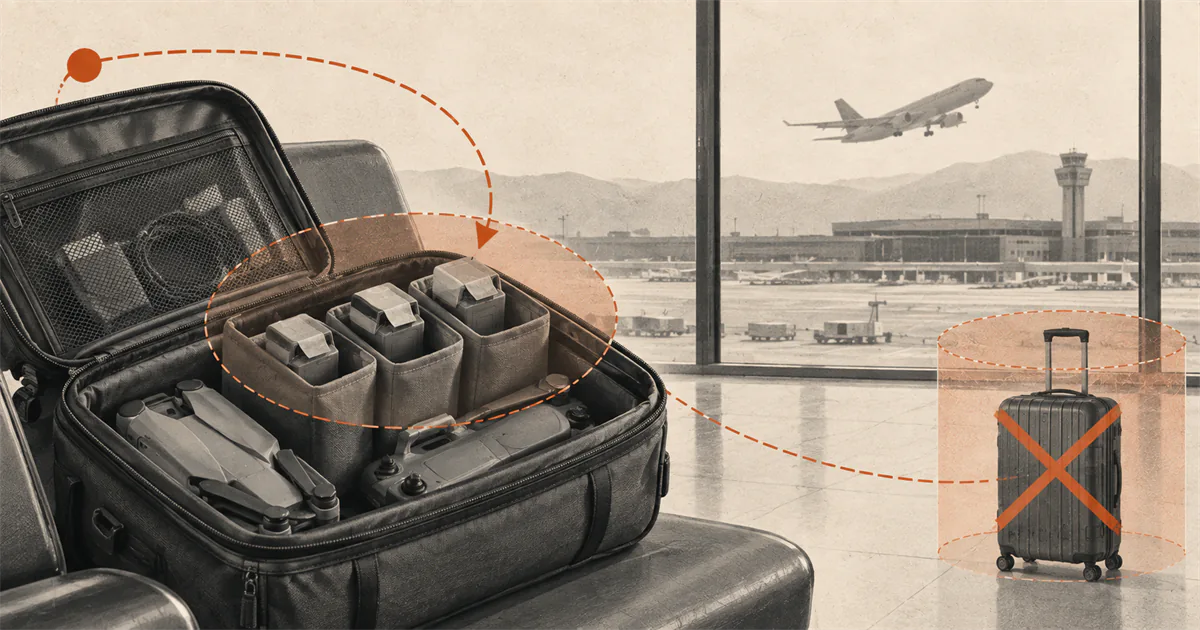
Under current US FAA guidance, spare rechargeable lithium batteries belong in carry-on baggage with terminals protected. Batteries up to 100 Wh fit the general passenger limit; 101 to 160 Wh need airline approval and are limited to two spares, while batteries above 160 Wh are generally prohibited on passenger aircraft. Airline, route, and country rules can be stricter.
Start with the exact battery and itinerary
Write down the battery model, chemistry, quantity, watt-hour rating, whether each battery is installed or spare, the airline, every connecting carrier, and the countries you will enter or transit. Do this before choosing checked or carry-on baggage.
Air-travel acceptance is not proof that a drone may be imported or flown at the destination. Customs, radio, registration, Remote ID, airspace, park, and land-manager rules are separate checks.
Use the current FAA and airline pages for the actual travel date. A screenshot from an older trip is not a packing rule.
Read watt-hours from the label or documentation
Use the watt-hour value printed on the battery or published by its manufacturer. Do not estimate from advertised flight time. When the label provides volts and amp-hours but no watt-hours, FAA guidance says watt-hours can be calculated by multiplying volts by amp-hours. If capacity is shown in milliamp-hours, convert it to amp-hours before multiplying.
Do not use a calculation to override an unreadable, damaged, or missing label when the airline requires clear identification. Obtain the exact manufacturer documentation or replace the pack.
Under current FAA PackSafe guidance:
- rechargeable lithium-ion batteries up to 100 Wh fit the general passenger size limit;
- spare batteries from 101 to 160 Wh require airline approval and are limited to two per person;
- batteries above 160 Wh are generally prohibited on passenger aircraft.
These are baseline federal boundaries. An airline can impose a lower quantity, different approval process, or additional handling rule.
Separate spare batteries from installed batteries
FAA guidance requires spare, uninstalled lithium batteries to travel in carry-on baggage only. This includes a battery removed from a drone, a charging hub that functions as a power bank, and other portable rechargers containing lithium cells.
Rules for a battery installed in a portable electronic device are a separate category. Do not assume that this automatically permits the drone in checked baggage. Check the airline’s drone-specific instruction.
American Airlines, for example, currently says drone batteries must be removed before travel and packed in carry-on baggage, while a drone without an installed battery may travel in checked baggage. Apply that only to an American Airlines itinerary and recheck it before departure.
Protect every spare terminal
Prevent the battery terminals from touching coins, keys, tools, other batteries, charging-hub contacts, or loose metal. FAA examples include original retail packaging, terminal tape, a battery case, a sleeve, or a snug protective pouch.
Choose a method that does not press on the case, cover an active vent, damage a smart-battery switch, or obscure identification needed by the carrier. Pack each battery so it cannot shift into another conductive object.
Do not treat a fabric bag alone as terminal protection unless it keeps each pack separated and prevents short circuit under the applicable guidance.
Prepare for a gate-checked carry-on
A carry-on bag can be taken at the gate or planeside even when you planned to keep it in the cabin. FAA guidance says spare lithium batteries and power banks must be removed before such a bag is checked and kept with the passenger in the aircraft cabin.
Place the protected battery pouch where it can be removed without unpacking the aircraft at the gate. Keep the watt-hour label and any airline approval accessible. Tell the gate agent that the bag contains spare lithium batteries before it leaves your possession.
Do not put the pouch into a checked bag to save space at the last minute.
Check the carrier’s quantity and drone rules
FAA guidance does not impose a quantity limit on most personal-use spare batteries at or below 100 Wh, but it warns that airlines may set stricter quantity and watt-hour limits.
American Airlines currently lists its own limits and says all drone batteries must be removed before travel. Another carrier may use a different personal-use quantity, approval channel, packaging rule, or restriction on in-flight charging.
Check:
- the operating carrier for every segment, not only the ticket seller;
- the number of spare drone batteries allowed;
- whether approval is required and how it is documented;
- rules for the drone in checked or carry-on baggage;
- power-bank treatment for a charging hub;
- carry-on size limits for the protected aircraft case;
- destination and transit-country requirements.
When two policies differ, follow the stricter applicable requirement or obtain written guidance from the carrier.
Exclude damaged, recalled, or uncertain batteries
Inspect every case, seam, contact, and label before leaving home. A swollen, cracked, leaking, wet, recalled, unusually hot, or otherwise damaged battery is not a travel candidate.
FAA PackSafe says damaged or recalled batteries and devices likely to create sparks or dangerous heat must not be carried aboard an aircraft unless the battery has been removed or otherwise made safe under the applicable requirements. Do not bring a questionable removable pack to the airport for a checkpoint decision.
Use the swollen-battery stop-use checklist and resolve the battery through the manufacturer and a qualified local disposal route before the trip.
Use a final packing sequence
- Confirm the exact battery models, quantity, watt-hours, and condition.
- Recheck FAA PackSafe and every operating airline.
- Obtain any required airline approval before travel.
- Remove batteries when the carrier requires it.
- Protect each spare battery from short circuit and physical damage.
- Place spares in an accessible carry-on pouch.
- Keep labels, manuals, and approval evidence available.
- Plan for removal if the carry-on is gate checked.
- Verify drone import and operating rules separately.
- After arrival, inspect every pack before charging or flight.
If the rating, condition, carrier rule, or approval is uncertain, leave the battery out of the trip until the responsible authority resolves it.
Sources
Check the underlying guidance.
FAA PackSafe establishes the US baseline for spare lithium batteries, watt-hour limits, terminal protection, damaged packs, and carry-on placement. American Airlines is included to show why the carrier's current drone and quantity rules must be checked separately.
- PackSafe - Lithium Batteries, Federal Aviation Administration. Government source. Checked . Used for spare-battery carry-on placement, terminal protection, watt-hour limits, quantity boundaries, damaged-battery restrictions, and the airline recheck.https://www.faa.gov/hazmat/packsafe/lithium-batteries
- Airline Passengers and Batteries, Federal Aviation Administration. Government source. Checked . Used to confirm that passenger battery allowances depend on battery type, installation, condition, size, and airline instructions.https://www.faa.gov/hazmat/packsafe/airline-passengers-and-batteries
- Restricted items in bags, American Airlines. Operator source. Checked . Used only as a current carrier-specific example requiring drone batteries to be removed and carried on, with its own quantity and size limits.https://www.aa.com/pubcontent/en_US/travel-info/baggage/restricted-items.html
Editorial disclosure: This guide summarizes current US FAA passenger-battery guidance and one current airline policy. DroneReviewed is not confirming acceptance for a specific itinerary, carrier, airport, country, battery, or aircraft.