Direct answer
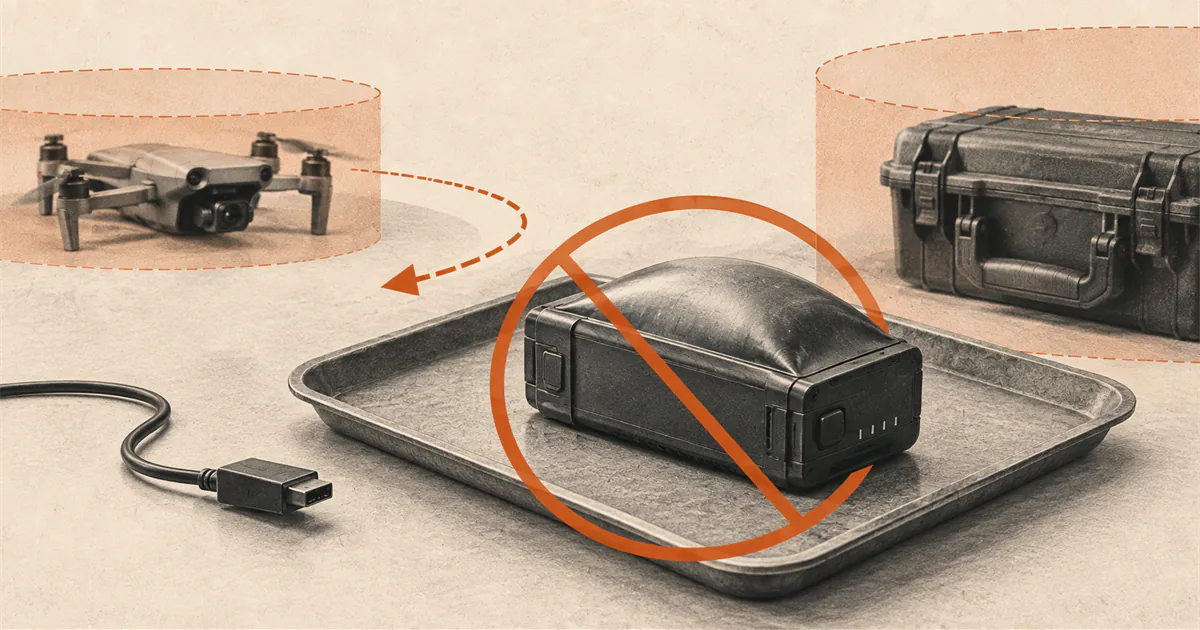
A swollen drone battery is a stop-use condition, not a reduced-performance battery.
Do not charge, install, fly, press, puncture, open, or deliberately discharge it. Keep people away from an immediate hazard, avoid unnecessary handling, and contact the manufacturer plus the appropriate local household hazardous-waste or specialized battery program for instructions. Do not put it in household trash, curbside recycling, a parcel, or passenger baggage.
Stop charging and flying
Swelling means the battery is damaged. DJI’s current aircraft-battery support page gives the clearest first decision: never use a swollen or cracked battery.
That means no more charging, no short test flight, no use as a power bank, and no attempt to see whether the aircraft can still close around it. Power down nearby equipment only when that can be done without touching or moving an unstable pack. Mark the battery as out of service so another person does not return it to the kit.
Do not use the battery simply because it still reports a normal percentage or fits with pressure. A display cannot reverse visible physical damage.
Check for an immediate hazard without handling it
From a safe distance, look for rapid heating, smoke, flame, hissing, leakage, a strong unusual odor, or continued expansion. Keep people and animals away. Do not lean over the battery or carry an actively failing pack through a building, vehicle, aircraft cabin, or crowded area.
EPA says battery swelling indicates damage and a potential fire hazard. If there appears to be an imminent fire risk, its guidance says emergency services may be needed. Follow local emergency instructions and prioritize distance and evacuation over saving the battery or surrounding equipment.
This page does not prescribe one extinguisher, container, or movement procedure. Battery construction, location, fire stage, and local emergency guidance matter. An improvised response can create new exposure.
Do not flatten, puncture, open, or discharge it
Do not press the case back into shape, pierce it to release gas, remove cells, repair the battery-management board, or connect a load to force the percentage down. Do not place it in water, salt water, a refrigerator, freezer, oven, microwave, fire, or direct sun.
Avoid taping directly across damaged material or placing the pack under a heavy object. Protect people from contact and protect the terminals from accidental short circuit only in a way approved by the manufacturer or local waste program.
The goal is not to make the battery look normal. It is to prevent reuse and obtain instructions from a qualified destination.
Contact the manufacturer first
Record the aircraft and battery model, serial or identifying label when it can be read without unsafe handling, purchase date if known, and the visible condition. Note whether swelling appeared during storage, charging, after impact, after water exposure, or after flight.
Contact the aircraft or battery manufacturer and describe the condition before shipping or taking the pack anywhere. DJI directs owners of swollen batteries to its support route. A manufacturer may have a warranty, recall, service, or local disposal process that differs by product and country.
Do not put the battery in ordinary mail or a parcel because a support form appears to request a return. Ask specifically whether the battery itself should be transported. DJI separately warns users not to send back an obviously swollen or leaking battery before contacting support.
Find the correct local disposal route
In the United States, EPA says lithium-ion batteries and devices containing them do not belong in household garbage or municipal recycling bins. Collection and sorting equipment can crush batteries and create a fire hazard.
Ask the manufacturer, retailer, state waste-management agency, local household hazardous-waste program, or specialized battery recycler how it accepts a damaged lithium-ion pack. Tell the program that the battery is swollen before arriving. A normal drop box may not accept damaged batteries.
Keep the battery in the safe location specified by the responsible authority until the approved handoff is arranged. Do not leave it in a hot car, public area, mixed battery bin, or ordinary recycling container.
Keep it out of passenger travel
Do not take a swollen battery to an airport to ask at the checkpoint. FAA PackSafe guidance says damaged or recalled batteries and devices likely to create sparks or dangerous heat must not be carried aboard an aircraft unless the battery has been removed or otherwise made safe under the applicable requirements.
The practical boundary for a swollen removable drone battery is simple: exclude it from the trip and resolve it through the manufacturer and local hazardous-waste route. The battery air-travel guide applies only after every pack passes inspection.
Inspect the rest of the system
Do not assume the event affects only one removable pack. Look for heat damage, residue, deformed battery bays, damaged contacts, charging-hub errors, impact marks, or water exposure. Do not install a healthy battery into questionable equipment until the exact manufacturer guidance supports that step.
Review how the battery was charged and stored, but do not turn that review into a diagnosis. Swelling can have different causes, and only qualified support should make a product-specific determination.
Use the stop-use checklist
- Stop charging, flying, and testing the battery.
- Keep people away and assess smoke, heat, leakage, hissing, flame, or continuing expansion from a safe distance.
- Use emergency services when there is an imminent fire danger.
- Do not press, puncture, open, repair, deliberately discharge, or improvise a treatment.
- Mark the pack out of service and prevent accidental reuse.
- Contact the manufacturer before moving or shipping it.
- Arrange an approved local hazardous-waste or specialized battery handoff.
- Keep it out of trash, curbside recycling, parcel networks, and passenger baggage.
- Inspect associated aircraft and charging equipment before any reuse.
A swollen battery does not return to service because it cools, reports a normal percentage, or can still be inserted. The decision is stop use and obtain a qualified disposition route.
Sources
Check the underlying guidance.
DJI states that swollen or cracked aircraft batteries must not be used. EPA treats swelling as battery damage and a potential fire hazard, while FAA passenger guidance excludes damaged batteries likely to spark or produce dangerous heat.
- What should I do if a battery is swollen?, DJI. Manufacturer source. Checked . Used for the direct manufacturer instruction never to use a swollen or cracked aircraft battery and to use the support route.https://repair.dji.com/help/content?customId=01700007637&lang=en&paperDocType=ARTICLE&re=US&spaceId=17
- Frequent Questions on Lithium-Ion Batteries, US Environmental Protection Agency. Government source. Checked . Used for the fire-hazard boundary, safe holding location, local management route, and exclusion from household trash and curbside recycling.https://www.epa.gov/recycle/frequent-questions-lithium-ion-batteries
- PackSafe - Lithium Batteries, Federal Aviation Administration. Government source. Checked . Used for the passenger-aircraft prohibition on damaged or recalled batteries likely to spark or generate dangerous heat.https://www.faa.gov/hazmat/packsafe/lithium-batteries
Editorial disclosure: This checklist combines current manufacturer, EPA, and FAA guidance. DroneReviewed has not opened, discharged, transported, or tested a swollen battery and does not provide a universal fire-response procedure.