Direct answer
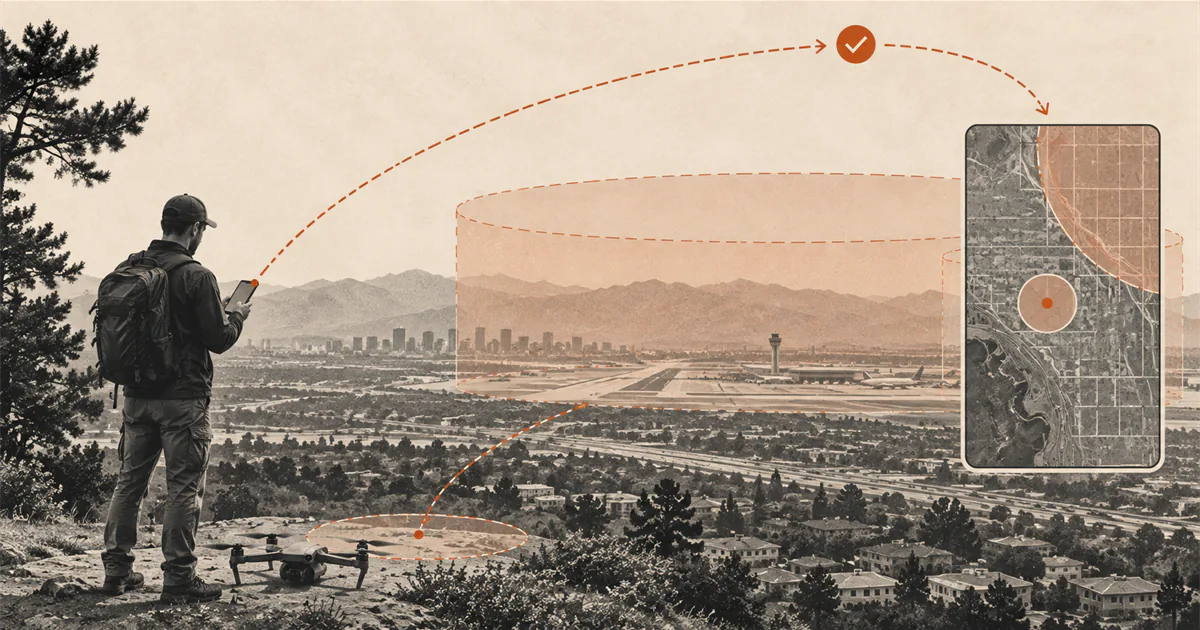
Use LAANC when an eligible recreational flight needs prior access to controlled airspace.
Complete TRUST and registration, choose a provider from the FAA's current approved list, enter the exact location, time, altitude, and operation details, and wait for an approval that covers the plan. Follow every condition and recheck TFRs, NOTAMs, weather, site access, and other restrictions. If LAANC is unavailable for the airport or request, use the applicable FAA DroneZone process rather than flying without authorization.
Decide whether LAANC is needed
LAANC is the Low Altitude Authorization and Notification Capability. It supports FAA airspace authorizations for eligible drone operations in controlled airspace around participating airports.
Do not request LAANC simply because an airport appears nearby. Use the current location-check process to identify the airspace at the exact point, route, date, time, and altitude. Recreational flight in Class G uncontrolled airspace does not use LAANC merely as a notification step, but all other recreational rules and restrictions still apply.
Complete the recreational prerequisites
The current FAA LAANC guidance says a recreational flyer must register the drone and complete TRUST before the first flight. Keep the registration and TRUST proof current and accessible.
LAANC does not decide whether the operation is truly recreational. A business, work, inspection, client, or other non-recreational purpose follows the appropriate operating rule and credentials. Start with the US recreational rules decision map when the purpose is uncertain.
Choose an FAA-approved service supplier
LAANC requests are submitted through desktop or mobile applications operated by companies approved by the FAA as UAS Service Suppliers. Use the current FAA list because provider availability and supported platforms can change.
The FAA does not endorse one listed provider over another. Review the provider’s privacy, account, device, and operational requirements separately. A general B4UFLY status in an app is not the same thing as an approved LAANC request.
Enter the operation exactly
Build the request around the operation you can actually conduct:
- exact location and operating area;
- date and time window;
- requested altitude;
- recreational operating rule;
- aircraft and registration information;
- reliable contact details;
- any other information the approved service requires.
The provider checks the request against FAA airspace data including UAS Facility Maps, airspace classes, airports, Temporary Flight Restrictions, Special Use Airspace, and NOTAMs. An eligible request at or below the applicable limit can receive near-real-time authorization.
Do not request the largest area, longest time, or highest altitude as a default. Ask only for the operation you can keep within visual line of sight and conduct safely.
Read the result and every condition
An approval is limited to the stated location, area, time, altitude, operating rule, and conditions. Save an accessible copy and keep it available during the flight. If the plan changes outside those limits, obtain a suitable authorization before proceeding.
A denial, pending request, failed app, or unavailable grid is not permission to fly. Recreational flyers cannot use the Part 107-only further-coordination path described by the current FAA LAANC page. Follow the provider and FAA instructions for an eligible revised request.
Unless an authorization specifically says otherwise, the FAA states that drone pilots do not need to notify the tower before flying under the authorization.
Use DroneZone when LAANC is unavailable
For controlled airspace around an airport that does not offer LAANC, the applicable recreational route may be a manual FAA DroneZone authorization. That process is not near-real-time. Submit at or below applicable UAS Facility Map altitudes and allow time for manual review.
Do not substitute a phone call, B4UFLY screenshot, or request reference number for an issued authorization.
Recheck the whole flight
LAANC provides airspace authorization only. It does not grant land access, override a TFR, approve unsafe weather, remove visual-line-of-sight duties, or replace another recreational requirement.
Immediately before takeoff, recheck current NOTAMs and TFRs, weather, people, other aircraft, site permission, Remote ID status, and the exact authorization conditions. Stop if the live situation no longer matches the approved plan.
Run the LAANC sequence
- Confirm the purpose is recreational and complete TRUST and registration.
- Verify that the exact operation enters controlled airspace where LAANC is available.
- Choose a provider from the FAA’s current approved list.
- Request only the exact place, time, area, and altitude needed.
- Wait for approval and read every condition.
- Keep the authorization accessible and remain inside its limits.
- Recheck all restrictions, weather, ground access, and hazards before launch.
No approval means no controlled-airspace flight.
Sources
Check the underlying guidance.
The FAA sources below define LAANC, recreational eligibility, approved service suppliers, request limits, DroneZone alternatives, and the boundary that authorization covers airspace only. Use the current provider and authorization terms for the actual operation.
- UAS Data Exchange (LAANC), Federal Aviation Administration. Government source. Checked . Used for LAANC purpose, approved suppliers, automated authorization, controlled-airspace scope, prerequisites, and remaining pilot responsibilities.https://www.faa.gov/uas/getting_started/laanc
- Airspace Authorizations for Recreational Flyers, Federal Aviation Administration. Government source. Checked . Used for the recreational request sequence, exact time, altitude and location, UAS Facility Map boundary, and DroneZone alternative.https://www.faa.gov/uas/recreational_flyers/authorization
- Recreational Flyers & Community-Based Organizations, Federal Aviation Administration. Government source. Checked . Used for the requirement to obtain prior authorization in controlled airspace and remain at or below the authorized altitude.https://www.faa.gov/uas/recreational_flyers
Editorial disclosure: This guide summarizes the current FAA LAANC workflow for US recreational flyers. It does not issue an authorization, guarantee approval, select a provider, or determine that another restriction or property rule permits a flight.